

Learning to read is one of childhood’s greatest milestones – and one of its most complex. English doesn’t make it easy: silent letters, shifting sounds, and countless exceptions can turn reading into a puzzle even for fluent adults. For young learners, especially boys, mastering that puzzle takes patience and practice – which is why at BBC, it’s a challenge we’ve embraced wholeheartedly
“We have many layers to our literacy support and extension programs,” explains Head of Junior School, Mrs Summa Todd. “It really starts in Prep, laying the foundation for boys to soar into amazing opportunities as they get older. For those who need continued support, we have programs ranging from individually tailored sessions to small groups and whole-class approaches.”
She acknowledges that reading doesn’t always come easily for boys – but says BBC’s approach is about engagement as much as skill.
“A lot of boys are reluctant readers at first. English is often seen as their least favourite subject because it’s reading-heavy. So, we make reading social, competitive, and fun. Readers Cup, for example, sees boys read multiple novels and then compete in a quiz, and our Year 6 Writer’s Workshop allows them to work with an author and publish their own stories. It’s
about making reading something to enjoy and be proud of.”
“Our library technician is also exceptional at sparking that enthusiasm,” she adds. “She sources books the boys are talking about, keeps popular titles well stocked, and tracks what they’re reading. It’s a team effort to create a culture where reading is part of everyday life.”
From learning to read to reading to learn
Since 2018, one of BBC’s most successful initiatives has been the Read Write Inc (RWI) program, an evidence-based approach to literacy instruction that lays the foundation for strong reading skills. Ms Lizzie Gresham, Year 2 Teacher and Reading Leader, said the synthetic phonics program teaches boys to decode words by learning sounds, blending them to read, and segmenting them to spell.”
“Read Write Inc gives our boys the tools they need and it’s more than phonics alone,” she said. “It pairs solid literacy foundations with great literature and
rich experiences. I’m so glad we chose it; it’s setting our boys up to be confident, capable readers and writers.”
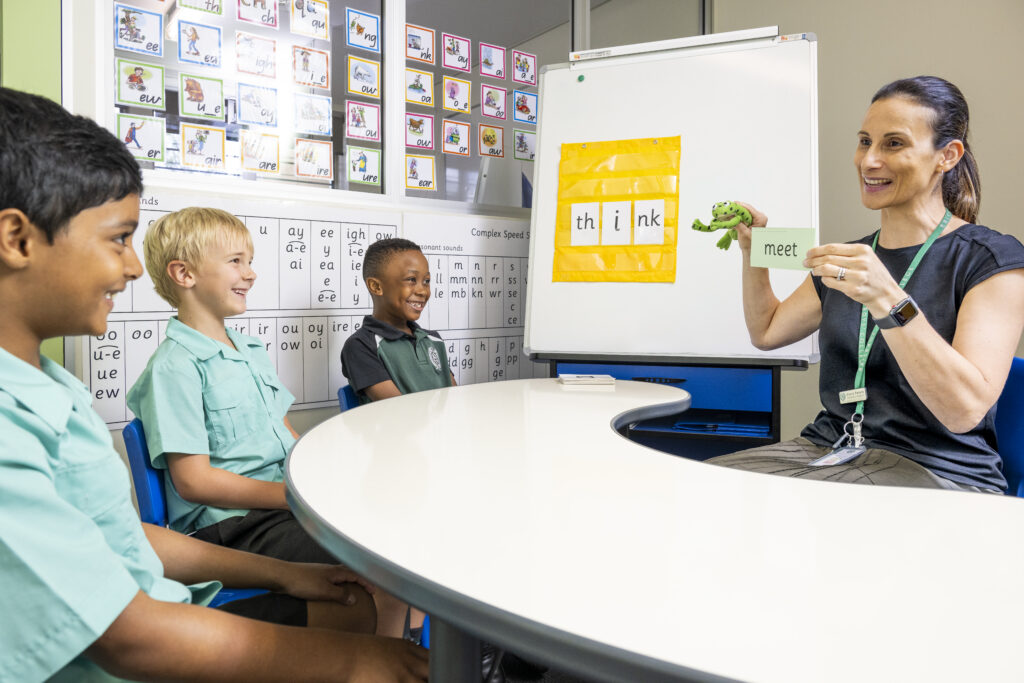
The program provides consistency from Prep to Year 2. Regular assessments and flexible grouping allows each student to work at a level suited to his development. From as early as Term 2 in Prep, boys are placed into small progress groups that encourage accelerated learners to move ahead while those needing additional support receive targeted teaching.
“Because the groups are small – often no more than 12 – we can really hone in on each boy’s needs,” Ms Gresham explains. “They’re reading books that match their ability, which means they feel successful, and that success builds confidence.”
Since its introduction, the results have been clear. “Our NAPLAN scores have improved, but more importantly, we see boys shift from learning to read to reading to learn,” Ms Gresham says. “When boys can read, the entire curriculum comes alive. They understand expectations, flourish under clear structures, and experience success every day. That fuels their motivation and confidence.”
One student who has felt that transformation is William McCabe. Now in Year 8, William credits Read Write Inc. with boosting not only his reading ability but his confidence across all areas of learning.
“RWI helped me understand what questions were actually asking, improve my comprehension, and build confidence in speaking and reading aloud,” he said. “By Year 8, I could understand my English assignments and essay questions so much better, and my grades improved significantly.”
William’s mother says the change has been profound. “His ability to comprehend both written and spoken text improved dramatically. William’s now an A-grade English student with a much deeper understanding of language,” she says. “RWI helped him move beyond simply doing reading, he now reads, writes and interprets with real confidence.”
The science of reading, applied by the art of teaching
What sets Read Write Inc apart from other literacy programs is its commitment to sustained quality. “We don’t just train teachers and walk away, we offer an ongoing model of support
and mentorship,” explains Ms Haley Goldsworthy, a Read Write Inc trainer who has partnered with BBC since 2018.
“At BBC, we’ve built a really strong working relationship. I run regular development days to keep implementation strong and consistent. Many programs can dilute over time, but our ongoing partnership helps staff maintain fidelity and rigour.”
This comprehensive support model has proven its worth across thousands of schools. RWI now works with more than 200 schools across Australia and nearly 7,000 in the UK, where it leads the phonics education field. “We see a clear link in national testing,” Ms Goldworthy says. “Students who progress successfully through Read Write Inc show measurable improvement in assessments like NAPLAN and schools often see significant improvement within two to five years, once a full cohort has been through the program from Prep.”
The program’s success is built on decades of research. Synthetic phonics helps most children, including those with dyslexia or learning English as an additional language, and RWI translates this science into a program teachers can confidently deliver. But Ms Goldsworthy emphasises that resources alone don’t create readers. “We often say programs don’t teach children;
teachers do. The program is strong, but it’s the commitment of teachers – the real engines behind it – that ensures every child learns to read.”
From the first tentative steps in Prep to the confident readers emerging in Year 6 and beyond, RWI lays a foundation for literacy success that extends across every subject and opens doors to every future opportunity.